

The Intimate Art of Dressing for the Body You Have Today
There may come a morning when a once-beloved bra feels unexpectedly insistent, a waistband leaves you longing for space, or lace that once delighted now feels too present against the skin. These shifts can be disorientating, particularly when your lingerie has long been part of how you recognise yourself. Yet your body has not failed a fitting, and you have not lost your sense of style. You are simply receiving new sensory information—and you are allowed to respond with tenderness.
What does a changing body need from lingerie now?
Bodies are beautifully changeable. Menstrual cycles, pregnancy, postpartum recovery, menopause, medication, stress, ageing, disability, changes in movement and ordinary fluctuations in weight can all influence how lingerie feels. Shape may alter gradually or seemingly overnight; breasts can feel fuller, softer or more tender, while the ribcage, abdomen, hips and skin may ask for a different kind of contact.
These changes can affect more than fit. They may reshape your relationship with garments that once felt familiar. A structured set might no longer offer the emotional ease it once did. Equally, after a period of wanting barely-there softness, you may find yourself craving the reassuring ritual of something more defined. Neither preference says anything about your confidence, desirability or commitment to self-care. Needs evolve, and lingerie can evolve with them.
Begin with sensation rather than size. Before considering what a label says, notice what your body is communicating when you dress:
- Pressure: Does any part of the garment feel demanding, pinching or difficult to forget?
- Tenderness: Would a gentler touch feel more supportive today, particularly across the breasts, ribs, abdomen or shoulders?
- Temperature: Are you feeling warmer, experiencing sudden heat or seeking an extra sense of cosiness?
- Skin awareness: Do seams, labels, lace edges or close contact feel more noticeable than they once did?
- Freedom: Can you breathe, sit, stretch and move without repeatedly adjusting what you are wearing?
- Emotional ease: Does the lingerie feel connected to who you are today, rather than to an earlier version of your body?
Some days, the answer may be a softer bralette, higher-rise briefs or a looser layer that gives the body room to settle. On others, you may want the composed feeling of a coordinated set, vivid colour or intricate detail. Comfort and beauty are not opposing ideas. Sensory ease can itself feel luxurious, while decorative lingerie can be chosen entirely for your own pleasure.
It is also normal to need more than one version of comfort. A body can fluctuate across a month, a season or even a single day. Rather than expecting one bra or brief shape to meet every need, consider creating a small wardrobe of options: pieces for tender days, warmer moments, gentle movement, deep rest and occasions when dressing feels especially expressive. This is not indulgence for its own sake; it is a practical acknowledgement that the body is alive and responsive.
If an old size no longer feels right, treat that information neutrally. Lingerie sizing is not a verdict, and numbers vary considerably between brands and styles. Choosing a different size is simply choosing the amount of space and support your present body prefers. The aim is not to force yourself back into a familiar label, but to find garments that allow you to inhabit your current silhouette without negotiation.
There can be grief in these transitions, especially when a favourite piece is tied to memory, identity or a previous life stage. You do not have to dismiss that feeling in the name of instant positivity. You might keep a treasured set for sentimental reasons, repurpose it, or let it go when you are ready. Making room for lingerie that feels right now does not erase who you were; it honours who you are becoming.
Above all, comfort is not a concession, a lack of glamour or a failure of confidence. It is a form of bodily autonomy. Listening when your skin asks for softness, when your temperature asks for lightness, or when your sense of self asks for something new is an intimate act of respect. The body you have today deserves lingerie that meets it without judgement—and brings pleasure, ease or quiet reassurance on your own terms.
Which fabrics feel calm, breathable and beautifully light against skin?
Next-to-skin comfort begins with fibre, but it does not end there. The way a fabric is knitted or woven determines how freely air can circulate, how readily the garment stretches and how much heat it holds. A fine, open knit may feel cooler than a dense version of the same fibre, while a smooth weave can reduce friction yet offer less give. Fabric weight matters too: lighter constructions generally feel airier, although an exceptionally dense lightweight fabric may still trap warmth.
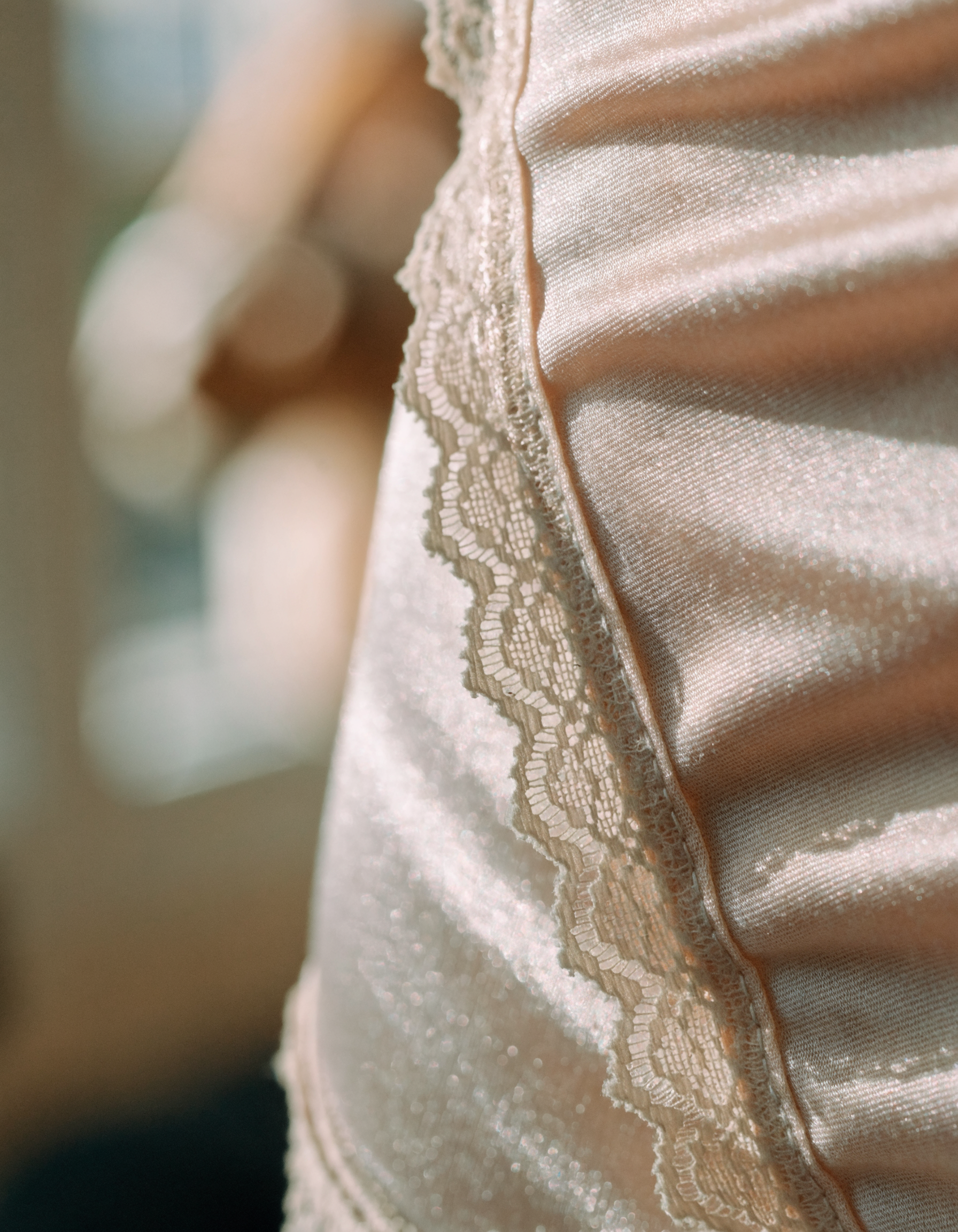
Moisture movement is equally important. Some fibres absorb vapour into their structure, helping the surface feel less clammy; others rely on the construction of the fabric to move moisture away from the body. Absorbency is not the same as quick drying: a material may take in moisture beautifully but release it slowly. For lingerie and sleepwear, the most comfortable choice is often a balanced fabric that feels smooth, allows airflow and dries at a pace suited to how and when you wear it.
- Modal: Made from regenerated cellulose, commonly sourced from beechwood, modal is prized for its fluid drape, fine surface and gently cool hand-feel. It absorbs moisture readily and is often knitted into soft jersey with excellent flexibility. Modal can feel beautifully light for everyday briefs, camisoles and loungewear, although very fine versions may benefit from careful washing to preserve their shape and surface.
- Bamboo-derived viscose: Despite its botanical-sounding name, this is usually a regenerated cellulose fibre rather than minimally processed bamboo. Its comfort comes from the finished yarn and fabric construction: it can be soft, absorbent and flowing, particularly in lightweight jersey. Quality varies considerably, so look beyond the word “bamboo” and assess fabric weight, recovery, seam finish and care instructions. It may dry more slowly than some synthetic performance fabrics.
- Mulberry silk: Silk’s exceptionally smooth filaments create a low-friction surface with a luminous, barely-there drape. It can help the body feel comfortably temperate because it manages moisture while offering gentle insulation without bulky weight. Woven silk charmeuse feels sleek and cool at first touch, while silk jersey has more stretch and a softer, cocooning character. Silk usually asks for more attentive care, including cool hand washing or a specialist delicate cycle, mild detergent and drying away from direct heat.
No fibre name is a complete promise. “Natural”, “plant-based”, “eco”, “breathable” and “luxury” are broad marketing terms, not reliable measurements of how a finished garment will behave. Modal and bamboo-derived viscose undergo substantial processing; silk is a natural protein fibre, yet its weave, dye, finish and garment construction still shape the wearing experience. Fibre blends can also be purposeful: a small amount of elastane may improve recovery and help a garment retain its ease, while too much synthetic content in a dense knit can reduce airflow.
When comparing pieces, hold the fabric up to the light. A little visible permeability can suggest better air exchange, although transparency alone is not proof of comfort. Gently stretch the material and release it: it should return smoothly rather than remain rippled. Then glide it across the inside of your wrist or forearm. Notice whether the surface feels silky and continuous or whether metallic threads, raised embroidery, stiff lace or heavy print finishes create drag.
The details that touch the body deserve as much attention as the main fabric:
- Soft, low-profile seams reduce raised points of friction; flatlocked, bonded or carefully enclosed seams can feel particularly unobtrusive.
- A breathable gusset in cotton, modal or another absorbent cellulose fabric supports airflow and moisture management where it matters most.
- Skin-conscious finishing means checking for scratchy labels, rigid thread ends, stiff elastic edges and decorative trims placed directly against delicate areas.
- Colour and surface treatments can alter hand-feel. Heavily printed, coated or embellished fabrics may feel less supple than the same base cloth in a simpler finish.
- Thoughtful laundering preserves softness. Cool water, mild detergent, a mesh wash bag and air drying can help protect fine fibres, smooth surfaces and stretch recovery.
For cool fluidity and easy everyday care, modal is a compelling choice. Bamboo-derived viscose can offer similarly soft, generous drape, but its quality should be judged garment by garment rather than by fibre story alone. Mulberry silk brings the lightest sense of polished luxury and surface smoothness, balanced by more considered care. The most soothing option is ultimately the fabric whose texture, airflow and maintenance feel harmonious with your skin, your routine and the way you wish to inhabit your body today.
How can thoughtful construction support without pinching or restraint?
Gentle support is less about holding the body still and more about distributing weight with care. In a well-engineered wire-free bra, the underband forms the principal anchor, while shaped seams, internal slings or bonded panels guide the bust within the cups. Wider straps then share the remaining load across a broader area. Each element contributes, so no single point has to work excessively hard.
Flexible cup architecture is particularly valuable when fullness changes through the month, across life stages or simply from one side of the body to the other. Stretch lace panels, softly moulded cups and multi-part cups with responsive upper edges can accommodate variation without demanding perfect symmetry. The aim is secure containment with enough ease for the ribcage, shoulders and bust to move naturally.
Construction details that create quieter support
- A broad, non-digging underband: A wider band spreads tension across more of the torso. Look for a smooth, resilient elastic that sits level around the body rather than curling, folding or concentrating pressure along one narrow edge.
- Reliable stretch recovery: Supportive elastic should extend as you breathe and move, then return to its original shape. If it remains overstretched after wear, the garment may begin to shift; if it barely yields, it may feel unnecessarily restrictive.
- Flexible cup shaping: Seamed cups, inner slings and strategically placed stretch panels can lift and centre through structure rather than rigid compression. A flexible neckline also allows for natural differences in volume.
- Wider, adjustable straps: Broader straps disperse pressure, while sufficient adjustment lets you fine-tune the cup position. Soft-backed hardware and front-adjusting designs can be especially useful when shoulder reach is limited.
- Adaptable fastenings: Four-row hook-and-eye closures offer useful increments of ease. A compatible extender can add temporary room without changing the whole bra, making it a thoughtful option when measurements or comfort preferences fluctuate.
- Flexible sizing: Styles spanning several cup or band measurements often combine adaptable cups with highly recoverable underbands. They can be particularly forgiving when the body does not remain at one precise set of numbers.
A three-part fit check
Rather than judging your body against the garment, assess whether the garment is doing its work. Try the bra on using the loosest comfortable hook first, then observe these three areas:
- Band tension: The band should feel secure and remain broadly level when you lift your arms. You should be able to take a full, unguarded breath. If the back rides upwards, the band may be too loose or the straps may be over-tightened; if the band feels sharply insistent, try a roomier setting, an extender or another size.
- Cup containment: Settle the bust gently into the cups, including the tissue at the sides. The cup edge should rest smoothly without cutting across fullness, while the base of the cup should stay close to the body. Gaping does not automatically mean the body is “wrong” or even that the cup is too large; a different cup shape or more flexible upper panel may simply suit you better.
- Freedom of movement: Reach forwards, raise your arms, rotate your shoulders and sit down. The bra should move with you without requiring repeated adjustment. Straps should remain in place without carrying the full weight of the bust, and the underband should support without restricting your range.
Make strap adjustments in small increments and consider each side independently; bodies are naturally individual rather than mechanically symmetrical. If tightening the straps causes the band to climb or the cups to pull upwards, loosen them and allow the underband and cup structure to resume their proper roles.
Above all, comfort should be present at the fitting—not promised after endurance. Thoughtful lingerie construction honours the silhouette you have today by offering responsive tension, adaptable space and support that feels secure without becoming controlling.
Could everyday lingerie become a quiet ritual of self-respect?
Lingerie can be one of the most private ways we acknowledge ourselves. Chosen without performance or permission, it becomes less about how the body appears and more about how we wish to inhabit it: comfortably, authentically and with a sense of personal agency. Even the simplest everyday pieces can offer this small assurance: I am worth dressing with care today.

Begin with the body you have now, rather than the one held in an old photograph, attached to a former size or imagined for some future date. This does not require constant positivity. It asks only for honesty and gentleness. Your lingerie drawer should serve your present life, giving you choices that feel dependable on ordinary mornings as well as pieces that bring private delight when you want them.
A thoughtful wardrobe need not be extensive. It simply needs to make getting dressed feel easy and self-directed. Consider creating a small, accessible collection around the rhythms of your week:
- Everyday favourites: the pieces you reach for instinctively because they allow you to move through work, errands and home life without distraction.
- Restful options: softly draped lingerie, slips or loungewear reserved for slower evenings, quiet weekends and moments of decompression.
- Private expressions of style: colours, embroidery, lace or matching sets chosen purely because they please you. No audience is required.
- Flexible choices: a few pieces that accommodate the natural shifts of your body and energy, so comfort is available without negotiation.
Place what you genuinely wear within easy reach, and release pieces that belong only to obligation, nostalgia or an expectation of changing yourself. If you are not ready to part with something, store it separately rather than allowing it to make each morning feel like a judgement. A drawer organised around the present body can be both practical and emotionally spacious.
Care is part of the ritual too. Fasten clasps before washing, use a gentle cleansing product, and give delicate pieces room to dry naturally. Fold or lay them away without overcrowding, so choosing tomorrow’s lingerie feels calm rather than hurried. These modest acts are not about preserving garments as museum pieces; they are a way of honouring the objects that accompany you so closely through daily life.
You might also let lingerie mark a transition in the day. Changing into something fresh after work, choosing a favourite colour before a demanding morning, or slipping into beautiful loungewear at bedtime can create a quiet boundary between effort and rest. This is sensory pleasure on your own terms: intimate style as reassurance, play or softness, according to what you need.
Confidence need not look like boldness, nor does self-love demand that you adore every part of yourself every day. Sometimes confidence is simply the absence of friction: having choices, feeling at ease and recognising yourself in what you wear. Dressing for today’s body is an act of dignity—not surrender, correction or compromise. Your body is already worthy of comfort and care, and your lingerie can affirm that truth in the most personal of ways.
Frequently Asked Questions
What lingerie is best when my body or comfort needs change?
Begin with how your body feels today, choosing adjustable designs, flexible bands and cups that move with your current silhouette. A considered fitting can clarify size and style without asking you to conform to a fixed ideal.
Which lingerie fabrics feel gentle against sensitive skin?
Soft cotton, breathable modal and luxurious silk can offer a calm, beautifully light sensation against the skin. Smooth seams, soft elastics and carefully placed French lace may also help minimise irritation.
How can everyday lingerie support confidence and self-love?
Choose pieces that feel pleasurable, secure and true to your personal style, whether that means quiet neutrals or dopamine-bright colour. Getting dressed can become an intimate daily ritual that honours your body exactly as it is today.