

The Sensory Scavenger Hunt: A Game to Reignite Your Spark
The Bottom Line
- Routine Kills Desire: Long-term relationships often fall into “autopilot,” where physical touch becomes functional rather than intentional.
- Sensation Over Performance: Shifting focus from “finishing” to “feeling” reduces performance anxiety and creates a safer space for intimacy.
- Gamification Works: Turning intimacy into a playful scavenger hunt triggers dopamine, making connection feel exciting rather than like a chore.
- Mindfulness is Key: Grounding yourselves in the five senses is a scientifically backed method to increase presence and emotional attunement.
Escaping the Autopilot Trap
It is February 2026, and the world is moving faster than ever. Between the demands of hybrid work, the constant ping of notifications, and the general hum of daily life, our relationships often pay the price. We drift into what relationship experts call “functional co-existence.” You might be sitting on the same sofa, watching the same holographic display, but you are miles apart emotionally. In this state, intimacy often becomes just another item on the to-do list—something to be efficient about, rather than savored.
Here at Twit2woo, we believe that the antidote to this stagnation isn’t necessarily a grand romantic vacation or a complete overhaul of your personality. Often, the solution is much simpler and closer to home: a return to the body. When we get stuck in our heads, worrying about bills or schedules, we lose touch with the raw data of the present moment. We stop seeing the way the light hits our partner’s hair; we stop noticing the texture of their skin.
Enter The Sensory Scavenger Hunt. This isn’t about winning or losing, and it certainly isn’t about reaching a specific sexual destination. It is a gamified approach to mindfulness designed to short-circuit your autopilot and plug you back into the electric current of connection. By turning your focus outward to specific sensory inputs, you lower the stakes and raise the fun, creating a playground where intimacy can flourish naturally.
The Philosophy: Why Gamification Heals Connection
Why turn intimacy into a game? It might sound counterintuitive to add rules to romance, but psychology suggests otherwise. Gamification introduces an element of “play,” which is essential for mammalian bonding. When we play, our brains release dopamine—the neurotransmitter associated with pleasure, reward, and motivation. In long-term relationships, the novelty that originally triggered that dopamine rush often fades. A game artificially reintroduces that novelty.
More importantly, this specific game is rooted in a concept known as Sensate Focus. Originally developed by researchers Masters and Johnson, Sensate Focus is a technique used to treat sexual difficulties by removing the pressure of performance. The goal is to touch and be touched without the expectation of intercourse or orgasm. According to the Mayo Clinic, exercises that focus on physical sensation rather than sexual outcome can significantly reduce anxiety and improve communication between partners.
By focusing on a specific “scavenger hunt” item—like finding a specific texture or sound—you distract the anxious part of your brain (the part that asks, “Am I doing this right?” or “Do I look okay?”). This allows your somatic awareness—your body’s felt sense—to take the wheel. You aren’t “performing sex”; you are simply investigating a sensation. This shift is subtle, but it changes everything. It transforms the bedroom from a stage into a laboratory of curiosity.
The Game Card: Your Sensory Roadmap
Ready to play? Below is your official Twit2woo Sensory Scavenger Hunt Game Card. You can write these down, print them out, or just keep them open on a tablet. The objective is not to rush through the list, but to linger on each item. Treat each prompt as a mini-meditation.
Sight: The Art of Gazing
Visual stimulation is often the first to be taken for granted. We look at our partners, but we rarely see them.
- The Shadow Play: Turn off the main lights and use a single, dim light source (like a candle or a phone flashlight facing the wall). Find a way to cast a shadow on the wall using your bodies that creates a shape neither of you has seen before.
- The Micro-Gaze: Set a timer for 60 seconds. Choose one square inch of your partner’s body (an elbow, the back of the neck, a specific tattoo) and study it as if you were going to paint it. Afterward, describe three details you noticed that you had never seen before.
- Visual Novelty: Find an item of clothing or an accessory that changes the visual landscape of your partner. This doesn’t have to be serious—playfulness is sexy. For example, donning a pair of Sexy Socks Bunny Style adds a whimsical, visual texture that breaks the norm and invites a giggle, which is a great tension releaser.
Sound: The Rhythm of Connection
Auditory cues can trigger deep emotional responses. Move beyond words and listen to the biology of your partner.
- The Heartbeat Hunter: Without using your hands to feel for a pulse, place your ear on different parts of your partner’s body (chest, back, neck) until you find the spot where their heartbeat is loudest. Sync your breathing to that rhythm.
- The Decibel Drop: Have a conversation where you must whisper so quietly that your lips must be touching the other person’s ear for them to hear you. Share a secret or a fantasy.
Smell: The Memory Trigger
Olfactory processing is directly linked to the limbic system, the emotional center of the brain.
- The Scent Guess: Blindfold your partner. Gather three distinct scents from around the house (e.g., a vanilla pod, a leather belt, a specific soap). Present them one by one. The goal isn’t just to identify the object, but to describe the feeling the scent evokes.
- Natural Pheromones: Find the spot on your partner’s skin that smells most like “them” (often behind the ear or at the nape of the neck) and inhale deeply for ten seconds.
Taste: The Blind Palette
Taste is intimate because it requires trust and vulnerability.
- Temperature Contrast: Find a beverage that is warm and one that is cool. Take a sip of one and kiss your partner, transferring the temperature sensation. Have them guess which it was before tasting the other.
- The Slow Melt: Place a small piece of chocolate or fruit in your partner’s mouth. Your goal is to consume it together without chewing, letting it dissolve between your tongues.
Touch: The Language of Skin
This is the largest organ and the most critical for bonding. The key here is variety—moving past the “standard” ways we touch.
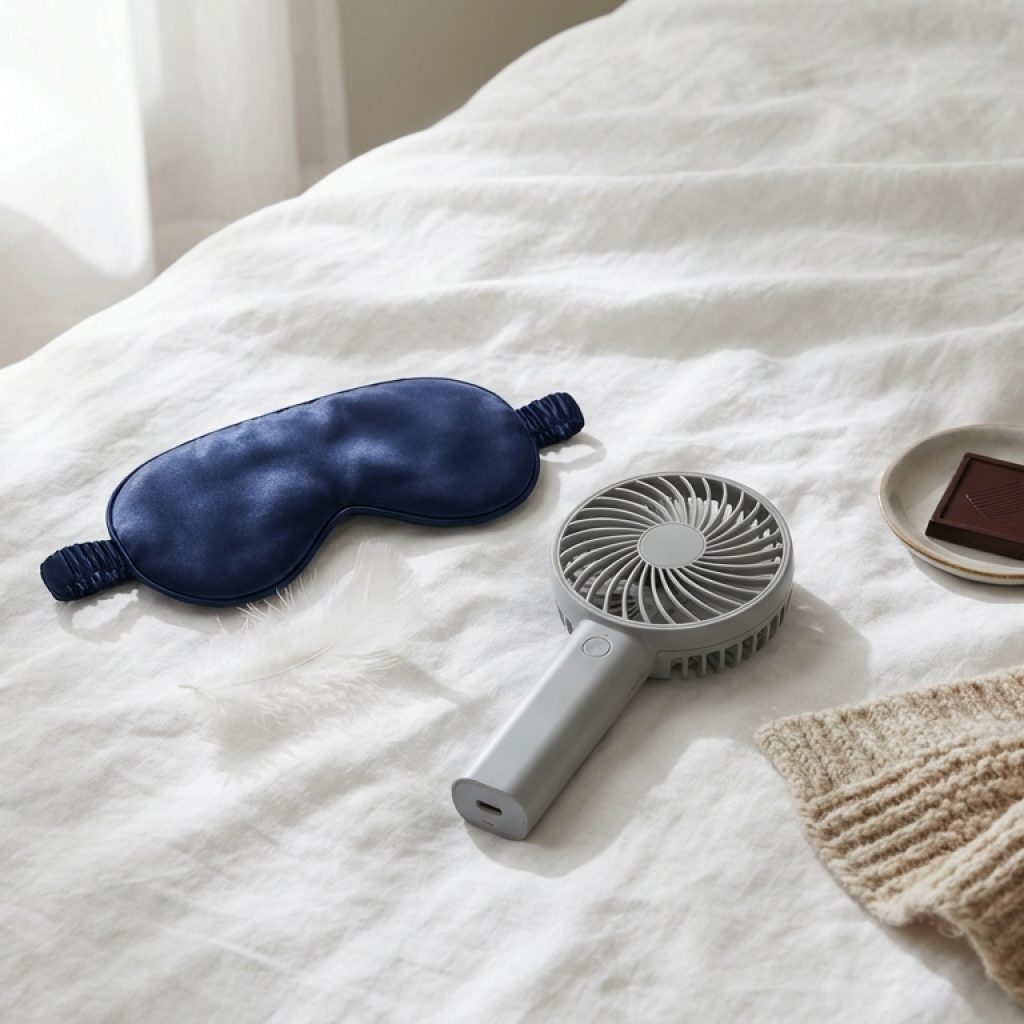
- The Temperature tour: Find an object that is cooler than room temperature (a metal spoon, a glass of water) and one that creates air flow. Trace the cool object along high-sensitivity zones like the collarbone or inner arm. Follow it immediately with air sensation. A tool like the Blow Me Light Up Pocket Fan is excellent for this; the sudden breeze on sensitized skin creates a “shiver” response that wakes up the nerve endings instantly.
- The Texture Map: Find three distinct textures in the room (e.g., silk, fur, denim). Blindfold your partner and run these textures over their skin. Ask them to rank them from “most soothing” to “most exciting.”
Instructions for Play
To get the most out of the Sensory Scavenger Hunt, you need to set the “container”—a safe psychological space where the outside world cannot intrude.
1. The Zone of Zero Distraction: Phones must be in another room or on “Do Not Disturb.” As of 2026, we know that the mere presence of a phone can reduce cognitive capacity and empathy. Remove the tech to increase the connection.
2. The Timer: It might seem unromantic, but setting a timer for 20 or 30 minutes can actually be liberating. It tells your brain, “For this amount of time, there is nowhere else I need to be.” It creates a boundary that protects your playtime.
3. Non-Verbal Dominance: Try to keep talking to a minimum, unless the prompt specifically asks for it (like the Whisper prompt). We rely too heavily on words to explain ourselves. Let your bodies do the talking. If something feels good, use sound (a sigh, a hum) rather than a sentence.
4. No End Goal: This is the most critical rule. The goal of the Scavenger Hunt is not to initiate sex. It often leads there, and that is wonderful, but if you go into it expecting sex, you are back in “performance mode.” If the timer goes off and you are just cuddling and laughing, you have won the game. If you end up entangled in the sheets, you have also won. The win is the connection, not the climax.
Conclusion: Small Moments, Big Impact
Reigniting the spark in a relationship doesn’t require a complete reinvention of who you are. It creates a bridge back to intimacy through the simple, grounded act of paying attention. By turning your focus to the sensory details—the hum of a fan, the texture of a sock, the rhythm of a heartbeat—you step out of the stress of the modern world and into the sanctuary of your relationship.
At Twit2woo, we encourage you to take this game and make it your own. Modify the rules, add your own sensory prompts, and remember that intimacy is supposed to be fun. It is a playground, not a boardroom. So, grab your partner, pick a sense, and start hunting for the spark that has been there all along, just waiting to be noticed.
Your Questions Answered
Yes, in fact, it is often recommended for exactly that situation. Because the game focuses on external sensory inputs rather than emotional processing or conflict resolution, it provides a neutral, safe ground to reconnect physically without the pressure to “fix” deep emotional issues immediately.

Recommended Product
Blow Me Light Up Pocket Fan Black
This product is the perfect tool for the “Touch” section of the scavenger hunt, allowing couples to experiment with temperature play and air sensation in a playful, low-pressure way.


About author